My dog, Aubrie, illustrates the "Golden Retriever Principle": In finance as in training, the most docile instruments tend to be adopted first.
On-chain credit is quietly rebuilding the fixed-income stack - starting with cash-like products
On-chain credit is quietly rebuilding parts of the fixed-income stack, starting with cash-like, short-duration products. This note explores why tokenization is moving from infrastructure experiments to institutional balance sheets—and why private credit and payments-linked assets may benefit most.
A short note on why tokenization is moving from infrastructure to balance sheets
The inflection point we’re living through
When I started exploring on-chain credit back in 2020, first with Fidelity and then with PlatformD’s team [1], the focus was primarily on the technology story: smart contracts, blockchains, and the promises of a new market infrastructure [2]. But what’s happening more quietly in 2025-26 is different, and I think far more exciting.
On-chain credit has begun to rebuild parts of the fixed-income stack from the bottom up, starting not with complex risks like structured notes or illiquid private debt, but with cash-like, short-duration products. Case in point, the USD50m money market tokenization we initiated with Sygnum Bank and Matter Labs back in 2023 [3].
This shift is now visible across a wide range of institutions. In July 2025, BNY Mellon and Goldman Sachs launched their tokenized money market funds solution [4], effectively moving from experimentation to an institutional balance-sheet solution. By December 2025, JPMorgan Asset Management had launched its first tokenized money market fund, MONY [5].
Why cash-like products move first – The Golden Retriever Principle
The official narrative was that fixed-income instruments, from bonds to money market funds, were best suited for tokenization, given the many technical steps involved in their issuance, their liquidity challenges, and their suitability as collateral. All fair. But the practical reality is that from the standpoint of an established financial institution dabbling with a new technology, you would typically start with an easy-to-explain, well-known, and stable product. If I start a career as an animal trainer tomorrow, I’ll begin with my Golden Retriever, not a tiger.
In fixed income, a Golden Retriever means:
Short duration,
Predictable cashflows,
Limited credit optionality.
That is why early on-chain credit adoption has concentrated around products like tokenized T-bills and cash equivalents (e.g., BlackRock’s BUIDL [6]), overcollateralized lending, and soon, short-tenor receivables and settlement-linked exposures.
These instruments minimize the need to sell a story (aka, “educate") investors and instead rely on process, controls, and transparency - areas where distributed ledgers (blockchains) add real value.
From infrastructure to balance sheets: The real inflection
What I’m excited to see changing recently is not the technology, but the institutional willingness to hold these instruments in institutional portfolios.
Large asset managers and infrastructure providers are no longer just experimenting with tokenization as a proof of concept. They are exploring how on-chain wrappers can:
improve settlement finality,
reduce operational friction,
increase auditability and reporting frequency,
and widen distribution without weakening controls.
This is a subtle but important shift, which demonstrates that the question has finally moved from“can we tokenize assets?” to “what assets benefit from being tokenized?[7]” Cash-like and short-duration credit products are a natural answer.
Why this matters for private credit
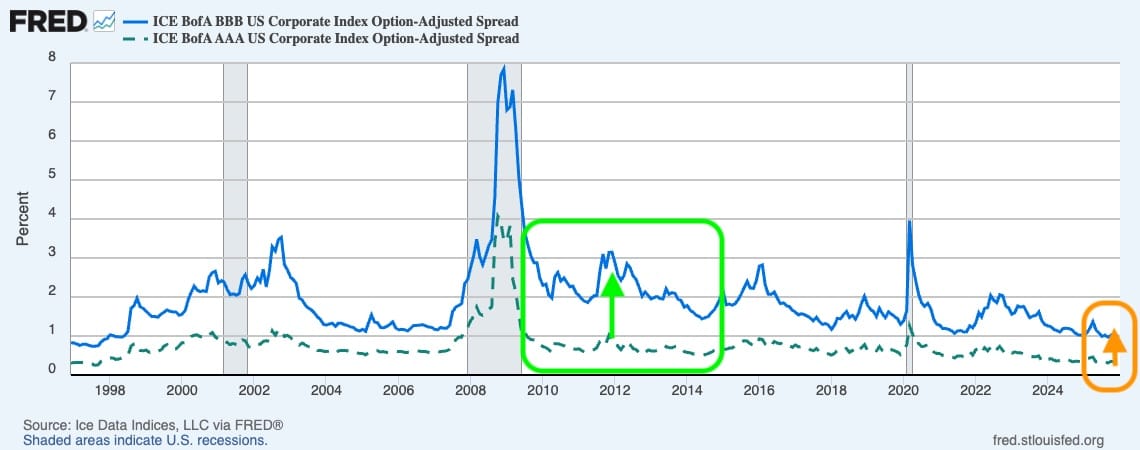
My thesis is that private credit is entering a phase where monitoring, control, and underwriting discipline matter more than headline yield. Why? Mostly because of valuation (see Fig.1), but also because of market concentrations, from AI-focused investments to a crowded direct lending space [8].
When credit spreads are tight and quality premia are compressed, as they have been over the past years, investors' margin for error narrows. In that environment, strategies that offer:
faster feedback loops,
higher-frequency data,
and enforceable eligibility rules
can behave very differently from longer-duration, lightly monitored credit - even if the underlying economic risk appears similar at inception (I discussed the distinction between loan-based credit and claim-based finance there). This is where on-chain structures become interesting: not as yield enhancers, but as risk-management and governance tools.
A rebuilding, not (yet) a revolution
None of this suggests a wholesale replacement of traditional fixed-income markets, not yet at least. What is happening instead is a layered rebuild:
traditional assets,
wrapped in new rails,
governed by tighter, more explicit rules.
If this trajectory continues, the early winners in on-chain credit will not be the most exotic products, but the ones that look more docile: cash-like, short-tenor, operationally robust. That's my Golden Retriever Principle.
Bridging traditional finance and digital assets, I’m a senior investment executive with 20+ years in asset management, fintech, and government advisory.